Karyn's Blog

Ideas, Lessons, and Musings on Kids' Money and Math

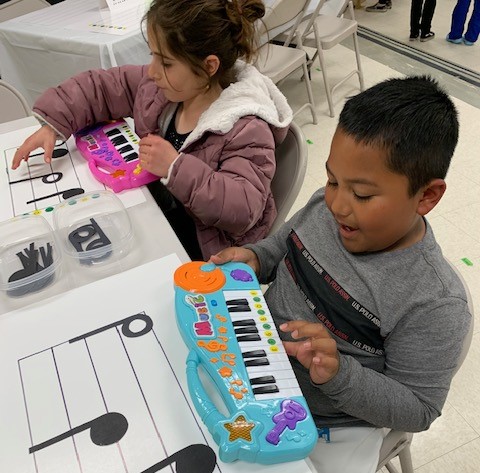
Testimonial: Nifty Numbers and Math Medley Family Math Night Event

It makes us smile when we receive letters like the following:

Dear Karyn,

I am absolutely delighted with the outcome last night. You cannot believe the amount of positive feedback that has been coming my way. Each and every family left here last night with a huge smile on their face. To quote, “That was awesome Mom”. One teacher said and I am not kidding here – Dad’s were over the top happy with the event they were giving her high fives. Another teacher had a conference this morning and the parent could not stop raving about Family Math Night. You were right the Student Council were shining stars. They were incredible! The compliments about them were just flowing!

The Superintendent was here working along side families. He stopped in my office this morning with a big smile on his face talking about the best Family Math Night he has ever seen. The Director of Curriculum was here and participated as well. She sent me the most awesome email. The Director of Special Education was here and she is in pictures working along side children. The Principals of both schools and all the staff the came to support the event have blogged, face booked and sent emails.

Most importantly are the students who attended. The staff told me from all grade levels Family Math Night is the buzz. Kids are already talking about next year. And I mean grade 6 students too. Oh yes parent and children alike told me last night and their teachers today, that they want to be on Student Council so they can do Family Math Night when they get to sixth grade.

A great big gigantic THANK YOU goes from me to you!!!! I have not stopped smiling myself.

~Mary, Math/Science Curriculum Specialist

This was sent a few minutes later: Ok I just have to share this. I just got an email from the PreK teachers and they are getting positive feedback as well. Who knew?

Posted in Family Math Night, Photos/testimonials | Leave a comment

Subitizing with Dominoes

I love doing this activity with kindergartners and first graders! Not only is it a great way for them to practice their addition facts but these little guys LOVE writing on their individual white board, so it’s a win/win! And it’s so simple. Here’s what you do:

Without turning it on, put ONE domino on the overhead projector or doc camera. Tell students that you are going to flash a domino for a few seconds and their job is to figure out how many pips (dots) they see all together and write it on their white board. Start with an easy one, like one pip on one side and one pip on the other side. Turn on the overhead for 2 seconds (longer for the younger ones). Give students a few seconds to write their answer and then have them hold up their boards for you to see. This was a simple one, so most students should have written the number ’2′ on their board. If not, they now know what to do.

Continue with flashing different dominoes while students figure out the total pips. After each one, it’s a good idea to have students share their strategies for figuring out the answer. The goal is to get them to subitize the pips. In other words, we want them to be able to quickly recognize a small grouping, such as 3 pips, without having to count each one.

Note: I always give students an option to ‘opt out’. Whenever we work with individual white boards and they do not know the answer, I have them write a question mark. I would rather have them write a question mark than show me a blank board. That’s because with the question mark, I know that they are telling me they can’t figure it out.

Connections to the CCSSM: K.CC.B.4b; KOA.A.1; K.OA.A.2; K.OA.A.3; K.OA.A.5; 1.OA.B.3; 1.OA.C.6

Posted in Activities, Family Math Night, Kids and Math K-2, Number and Operations, Problem-Solving | Tagged , , , , , , | Leave a comment

Reason Abstractly and Quantitatively

Estimates help us predict the reasonableness of an answer. Having students make an estimate before they perform the calculation, and even writing the estimate next to the problem, can help them to focus on making the numbers (and the problem) make sense.

Example: 3.2 x 9.8 =

Students use benchmarks to determine that 3.2 is close to 3 and 9.8 is close to 10, therefore, a reasonable estimate would be 3 x 10 = 30.

If students perform the actual computation and get 313.6, they know they need to revisit their work.

Sometimes I have my students complete their practice problems by simply having them make estimates – no calculated answers allowed! It may take awhile for students to get used to this as they are so used to turning in answers. But it’s a simple and powerful way to build number sense in our students. It forces them to look at the numbers and understand the operations they are performing on them. And it allows you, the teacher, to assess their understanding. Over time, making sense of the reasonableness of their answers will become a part of their problem-solving routine.

Posted in Activities, Family Math Night, Kids and Math 3-5, Kids and Math K-2, Number and Operations, Number and Operations, Problem-Solving, Problem-Solving | Tagged , , , , , , | Leave a comment

Multiplication Facts the Fun Way

Here’s a super simple activity that helps students to “see” multiplication facts. It’s also a great way for them to see the connection between addition and subtraction as they “use addition to find the total number of objects arranged in rectangular arrays” (CCSSM 2.OA.C.4) and to “interpret products of whole numbers” (CCSSM 3.OA.A.1).

Using inch graph paper, have students make rectangular arrays and record the rows (horizontal) and columns (vertical) as multiplication equations. This is a good time to discuss the vocabulary factor and product.

And while we’re at it, let’s throw in some geometry by showing students that a 2 by 3 array is the same as a 3 by 2 array…they are congruent.

Algebra?? Absolutely! The product of 2 x 3 is the same as the product of 3 x 2. The Commutative Property of Multiplication. Ask students how knowing this property can help them.

Here’s a video I put together a long time ago that talks about this and other concepts that can be taught by rectangular arrays:

Connections to the CCSSM: 2.OA.C.4; 3.OA.A.1; 3.OA.A.3; 3.OA.A.4; 3.OA.B.5; 3.OA.C.7

Posted in Activities, Algebra, Algebra, Family Math Night, Kids and Math 3-5, Kids and Math K-2, Number and Operations, Number and Operations | Tagged , , , , , , , , | Leave a comment

How Children Succeed: Grit, Curiosity, and the Hidden Power of Character

I just finished reading the book How Children Succeed: Grit, Curiosity, and the Hidden Power of Character by Paul Tough. Here’s how I summarized it on my Family Math Night facebook page:

“Kids succeed in a stress-free, nurturing environment where delayed gratification is encouraged and perseverance is developed through “managed” failure.”

Instead of writing a long book review, I thought I’d simply list below all the sentences I highlighted while reading the book. It will give you a good idea of the book’s messages.

- Those traits – an inclination to persist at a boring and often unrewarding task; the ability to delay gratification; the tendency to follow through on a plan – also turned out to be valuable in college, the workplace, and life generally (xix)

- children who grow up in a stressful environments generally find it harder to concentrate, harder to sit still, harder to rebound from disappointment, and harder to follow directions. And that has a direct effect on their performance in school (17)

- parents and other caregivers who are able to form close, nurturing relationships with their children can foster resilience in them that protects them from many of the worst effects of a harsh early environment (28)

- high-quality mothering can act as a powerful buffer against the damage that adversity inflicts on a child’s stress-response system (32)

- warm, sensitive parental care created a “secure base” from which a child could explore the world (34)

- children with a secure attachment early on were more socially competent throughout their lives: better able to engage with preschool peers, better able to form close friendships in middle childhood, better able to negotiate the complex dynamics of adolescent social networks (35)

- …responding sensitively to infants’ cues…seem to have had a powerful and long-lasting effect on the children’s outcomes in a variety of similar ways: the human…babies who received the extra dose of early care were, later on, more curious, more self-reliant, calmer, and better able to deal with obstacles. The early nurturing attention from their mothers had fostered in them a resilience that acted as a protective buffer against stress. (37)

- conscientiousness…predicts so many outcomes that go far beyond the workplace. People high in conscientiousness get better grades in high school and college; they commit fewer crimes; and they stay married longer. They have fewer strokes, lower blood pressure, and a lower incidence of Alzheimer’s disease. (71)

- …a set of strengths that were…expecially likely to predict life satisfaction and high achievement: grit, self-ontrol, zest, social intelligence, gratitude, optimism, curiosity (76)

- moral character…which embodies ethical values like fairness, generosity, and integrity (78)

- performance character…which embodies values like effort, diligence, and perseverance (78)

- …what kids need more than anything is a little hardship: some challenge, some deprivation that they can overcome, even if just to prove to themselves that they can (84)

- …the best way for a young person to build character is for him to attempt something where there is a real and serious possibility of failure (85)

- “The idea of building grit and building self-control is that you get that through failure.” (86)

- …students do much better academically if the believe intelligence is malleable (97)

- The most impressive effect was seen in the math scores of female students. The effect of stereotype threat has been well documented in the math scores of girls and women, who seem to be especially anzious in testing situations when they think tey might confirm the stereotype that girls are bad in math. In the Texas experiment, girls who received the standard anti-drug message averaged 74 on the test, about eight points below the male students who heard the same message. The girls who heard a growth-mindset message averaged about 84, closing the gap with the male students completely. (98)

- The far better predictor of college completion was a student’s high-scool GPA. (152)

- …standardized-test socres were predicted by scores on pure IQ tests and that GPA was predicted by scores on tests of self-control (153)

- …high-school grades reveal muchmore than mastery of content. They reveal qualities of motivation and perseverance – as well as the presence of good study habits and time management skills – that tell us a great deal about the chances that a student will complete a college program. (153)

- “The idea of building grit and building self-control is that you get that through failure.” (177)

- …the most reliable way to produce an adult who is brave and curious and kind and prudent is to…protect him from serious trauma and chronic stress; then, even more important, you provide him with a secure, nurturing relationship with at least one parent and ideally two. (182)

- (a child needs) discipline, rules, limits; someone to say no. And what he needed more than anything was some child-size adversity, a chance to fall down and get back up on his own, without help (183)

- (parents) need to help (our child) learn to manage failure (183)

Posted in Brain Based Learning, Family Math Night | Tagged , , , , | Leave a comment